

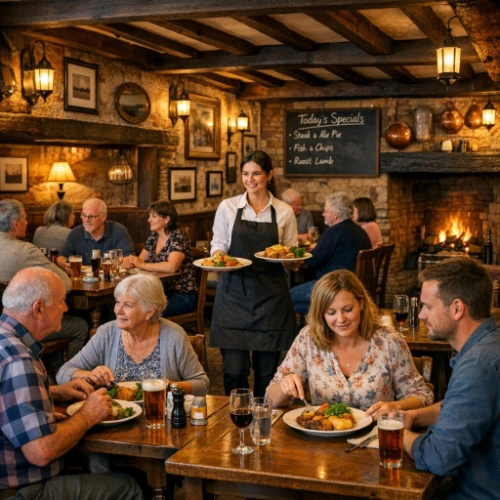
Wilmslow is known for its busy hospitality scene, with restaurants, bars, and cafés attracting consistent footfall throughout the week. These environments are designed to be welcoming and functional, but they also present a range of risks due to constant movement, food service, and changing conditions.
If an accident occurs in a restaurant or bar, the key question is not simply what happened. It is whether the business took reasonable steps to keep the environment safe for customers and visitors.
A successful claim depends on whether the risk that caused the injury should have been identified and managed before the incident took place.
Why hospitality environments carry unique risks
Restaurants and bars operate differently from many other public spaces. Staff are moving quickly, floors can become wet or obstructed, and lighting may be deliberately low. Tables, chairs, and service areas are constantly being rearranged.
These factors create an environment where hazards can appear quickly. Because of this, businesses are expected to actively monitor conditions and respond to risks as they arise.
The standard is not perfection, but reasonable management of foreseeable risks.
How accidents in restaurants and bars typically happen
Accidents in hospitality settings often develop from everyday situations that are not addressed in time.
Common causes include:
- spills that are not cleaned promptly
- wet floors without warning signs
- poorly positioned furniture creating trip hazards
- inadequate lighting in walkways or stair areas
- overcrowding or poor layout
The issue is not simply that these hazards exist, but whether they were managed appropriately.
Who is responsible for safety in a hospitality setting
Responsibility usually sits with the business operating the restaurant or bar. This includes ensuring that the premises are safe, staff are properly trained, and hazards are dealt with quickly.
In some cases, responsibility may extend beyond the business itself. For instance, if the premises are a part of a larger complex or managed building, a third party may be responsible for certain aspects of safety.
Understanding who controlled the area where the accident occurred is essential when assessing a claim.
Scenario example: Slip in a Wilmslow restaurant
A customer walks through a restaurant and slips on a liquid spill near a service area.
If the spill had been present long enough that staff should have noticed and cleaned it, responsibility is more likely to arise. If there were no warning signs in place to alert customers to the hazard, this further strengthens the position.
If the spill occurred moments before the accident and staff had no reasonable opportunity to respond, establishing responsibility becomes more difficult.
The outcome depends on how the situation was managed, not just the presence of the spill.
When you may be able to claim compensation
You may be able to claim compensation if your injury was caused by a failure to manage a risk that should have been addressed.
A claim is more likely where:
- the hazard was foreseeable
- the risk existed long enough to be identified
- no action was taken to prevent the accident
- the injury is directly linked to that failure
These factors help demonstrate that the accident could have been avoided with reasonable care.
When a claim may be more difficult
Not all accidents in restaurants or bars result in a successful claim.
A claim may be less likely where:
- the hazard appeared suddenly
- staff responded appropriately within a reasonable timeframe
- the environment was being properly monitored
- there is limited evidence of what caused the accident
In these cases, proving that the business failed in its duty becomes more challenging.
Evidence that supports a hospitality accident claim
To assess whether a claim can be made, it is important to gather evidence that shows how the accident occurred.
This may include:
- CCTV footage from the premises
- incident reports recorded by staff
- photographs of the hazard
- witness statements from other customers
- medical records confirming the injury
This evidence helps establish whether the risk was managed appropriately.
How compensation claims are approached
Hospitality accident claims focus on whether the business met its responsibility to keep customers safe.
Marley Solicitors approaches these cases by examining how the premises were managed, how quickly hazards were addressed, and whether appropriate safety measures were in place. Analysing these factors allows us to determine if we could have prevented the accident.
Time limits for making a claim
In most cases, you have three years from the date of the accident to begin a claim. Acting sooner makes it easier to gather evidence and assess the situation accurately.
Understanding your position after an accident in a restaurant or bar
If you have been injured in a restaurant or bar in Wilmslow, your ability to claim depends on whether the business failed to manage a risk that should have been addressed.
Where a hazard was present and not dealt with in time, a claim may be possible. Where the situation was managed appropriately or occurred too quickly to be prevented, the position becomes less clear.
Whether proper environmental management could reasonably have prevented the accident is the key issue.