

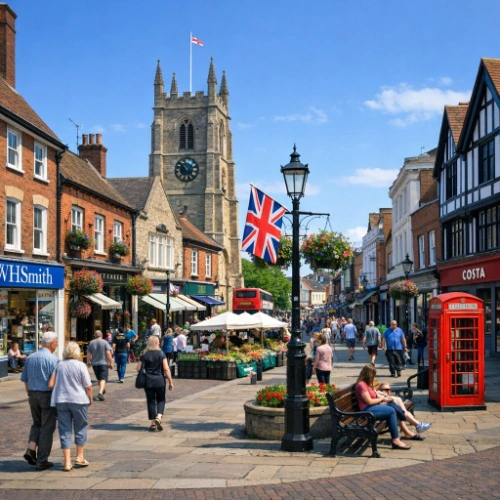
Chester City Centre sees a constant mix of residents, commuters, and visitors moving through retail streets, historic walkways, and hospitality venues. With that level of foot traffic, accidents are not rare. What is rare is a claim succeeding without the right evidence behind it.
In practice, the strength of a personal injury claim in this environment hinges on the ability to prove the incident and identify the responsible party.
Assumptions do not win claims. Evidence does.
A slip on a wet floor, a trip on uneven paving, or an injury inside a shop may seem like a clear case. Legally, it is not clear until it is supported by verifiable proof. That is the standard applied by insurers and courts.
Understanding what evidence actually carries weight is the difference between a claim progressing or being rejected early.
How accidents typically happen in Chester City Centre
The setting matters because it determines what evidence is available and who may be liable.
In Chester City Centre, common situations include:
- Slipping inside shops, cafés, or restaurants where spills or cleaning have not been managed properly
- Trips on uneven paving, loose slabs, or poorly maintained walkways
- Falls on steps, entrances, or historic surfaces that become hazardous in wet weather
- Incidents in busy retail areas where hazards are not cleared quickly enough
Each of these situations creates a different evidential path. There is no single checklist that applies to all cases.
The core principle: proving liability, not just injury
A successful claim requires two things to be demonstrated together:
- That an injury occurred
- That another party failed in their duty of care and caused that injury
Most people focus only on the first part. The second part determines whether claims succeed or fail.
For example, a fall alone is not enough. You must show that the hazard existed long enough or was obvious enough that it should have been addressed.
What evidence actually strengthens a claim?
Not all evidence carries equal weight. The best forms show the environment’s condition at the time of the incident.
The following are consistently relied upon in Chester City Centre claims:
- Photographs of the exact hazard (spill, defect, obstruction) taken as close to the time of the accident as possible
- CCTV footage from nearby shops, businesses, or public areas
- Incident reports recorded by staff or property managers
- Witness details from people who saw the accident or the hazard beforehand
- Medical records linking the injury to the incident
What matters here is timing and clarity. A photo taken immediately is far more powerful than one taken later after the hazard has been removed.
Scenario example: slip inside a retail unit near the Rows
A visitor walking through a shop just off the Rows slips on a recently mopped floor. There is no visible warning sign in place.
At first glance, this looks straightforward. In reality, the outcome depends entirely on evidence:
- If CCTV shows the floor was cleaned moments before and no sign was placed, liability becomes much easier to establish
- If staff logs show the area was checked and marked, the claim becomes more difficult
- If no report is made at the time, the business may dispute that the incident happened as described
The same accident can lead to completely different outcomes depending on what is recorded.
Where people weaken their own claim
Most claim issues are not caused by the accident itself, but by what happens immediately after.
Common mistakes include:
- Leaving the scene without reporting the incident
- Failing to take photographs while the hazard is still present
- Not collecting witness details
- Delaying medical attention, which weakens the link between incident and injury
These gaps create uncertainty. Uncertainty is what insurers rely on to reject or reduce claims.
Who may be responsible in Chester City Centre
Responsibility depends on location and control of the space.
A business may be liable for hazards inside their premises. A local authority or property manager may be responsible for public walkways. In some cases, responsibility can be shared.
This is why evidence must not only show what happened but also where it happened and who controlled that environment.
How Marley Solicitors approach these claims
At Marley Solicitors, the focus is not just on whether an accident occurred but on whether it can be proven to the required legal standard.
That involves:
- Securing CCTV before it is deleted
- Identifying the correct liable party early
- Structuring evidence so liability is clear rather than assumed
- Ensuring medical evidence supports the timeline of events
Without this structure, even valid claims can lose strength quickly.
Is it worth making a claim?
The key consideration is not how serious the accident felt at the time, but whether liability can be demonstrated with evidence.
If there is clear documentation of the hazard, a record of the incident, and supporting medical evidence, a claim is far more likely to progress.
If those elements are missing, the claim may still be possible, but it becomes more complex and more heavily disputed, often requiring additional evidence or witness testimonies to support the case.
Final point: Evidence decides everything
Accidents in Chester City Centre happen in environments that are constantly changing. Hazards are cleaned, repaired, or removed quickly. That means the window to capture evidence is short.
The earlier evidence is secured, the stronger the position.
If you are unsure whether your situation meets the threshold for a claim, getting it assessed early allows the evidence to be preserved and reviewed properly before it is lost.