

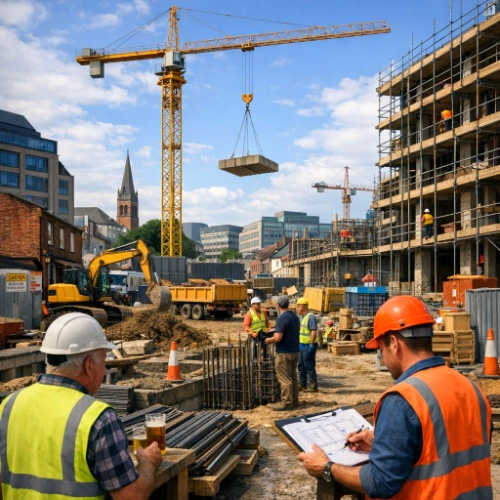
Construction sites in Widnes involve multiple contractors, subcontractors, and supervisory roles operating at the same time. Unlike many other workplaces, responsibility is not always held by a single employer. Tasks are divided, environments are shared, and safety depends on coordination between different parties.
When an accident occurs, the key question is not simply what happened, but who was responsible for the part of the site or task that caused the risk. Identifying the correct party is what determines whether a claim can be made and how strong that claim is likely to be.
In construction-related claims, establishing responsibility requires a clear understanding of who controlled the work, the environment, and the safety systems in place at the time.
Why construction accidents are different
Construction sites operate with layered responsibility. A worker may be employed by one company, working under the direction of another, on a site managed by a third party. Each of these roles carries its own obligations.
This structure means that responsibility is rarely obvious at first glance. An accident may appear to be caused by one issue, but the underlying failure may sit elsewhere within the chain of control.
Understanding how responsibility is divided is essential before any claim can be properly assessed.
Contractor responsibility compared with site-wide control
Responsibility on a construction site in Widnes is often split across different levels.
Contractor responsibility
A contractor is usually responsible for how specific tasks are carried out. This includes the tools used, the immediate working practices, and the safety of the activity itself. If an injury occurs due to unsafe methods or poorly maintained equipment, the contractor may be responsible.
Principal contractor or site manager responsibility
The party overseeing the site has a broader role. This includes coordinating activities, managing access, and ensuring that the overall environment is safe. Failures at this level often involve poor planning, lack of supervision, or unsafe site conditions.
Developer or client-side responsibility
In some cases, responsibility may extend to those overseeing the project at a higher level. Decisions around site design, timelines, or resource allocation can influence safety. Where these decisions create unsafe conditions, this layer may also become relevant.
The same accident can be linked to different parties depending on where the failure occurred.
How liability is actually determined
Liability in construction site accidents is based on control.
The key questions are:
- who controlled the task being carried out
- who controlled the area where the incident occurred
- who was responsible for ensuring safety procedures were followed
By answering these questions, it becomes possible to identify where responsibility sits.
In Widnes construction cases, Marley Solicitors often focuses on isolating the exact point where control broke down, rather than relying on assumptions about who should be responsible.
Scenario example: Scaffolding incident on a Widnes site
A worker is operating on scaffolding as part of a building project. The structure has not been properly secured, and during use, part of it becomes unstable, leading to a fall and injury.
Initially, one might assume that the scaffolding itself is the problem. However, responsibility depends on who was responsible for its installation, inspection, and approval for use.
The contractor responsible for the scaffolding’s incorrect erection may face liability. If the structure is not properly inspected or approved before use, responsibility may shift to site management.
The outcome depends on identifying which parts of the system failed and who controlled them.
When more than one party may be responsible
Construction accidents do not always involve a single point of failure.
There are situations where multiple parties contribute to the conditions that lead to an injury. A contractor may carry out a task unsafely, while site management fails to identify or correct the issue. In these cases, responsibility can be shared.
Shared liability does not prevent a claim. It changes how responsibility is allocated and how the claim is structured.
Understanding how different roles interact is essential in determining how responsibility is divided.
Where claims become more difficult
Some construction site accidents are harder to assess than others.
Claims become more complex where:
- responsibility is unclear or disputed
- documentation does not clearly show who controlled the work
- multiple subcontractors are involved with overlapping roles
In these situations, establishing a clear link between the injury and a specific failure becomes more challenging.
This is why early assessment is important, particularly in environments where responsibilities are not immediately obvious.
Evidence that helps identify responsibility
Construction claims rely on evidence that shows how the site was managed and how work was carried out.
Relevant evidence may include:
- site records and daily logs
- risk assessments and method statements
- inspection reports for equipment or structures
- supervision records
- witness accounts from those present on site
This type of evidence helps establish who controls the relevant part of the site and whether proper procedures were followed.
How construction accident claims are approached
Construction claims require a detailed understanding of how responsibility is divided across a site.
Marley Solicitors approaches these cases by examining who controlled each element of the work and identifying where a failure occurred. By focusing on the structure of responsibility, rather than assumptions, it becomes possible to build a clearer picture of liability.
This approach allows the claim to be directed at the correct party, which is essential in achieving a successful outcome.
Understanding your position after a construction site accident
A construction site accident in Widnes may support a claim where there is clear evidence that a party responsible for safety failed to meet their obligations.
The claim’s strength hinges on pinpointing the individual responsible for the risk and determining if prevention was necessary.
Where responsibility is clearly established, the position becomes stronger. Where it is unclear, further investigation is required to determine whether a claim can be supported.